
Yes, moissanite usually passes a basic diamond tester, but not a multi-tester. Most pen-style testers measure how fast heat moves through a stone. Moissanite conducts heat almost as well as diamond, so a heat-only tester often reads it as diamond. Newer multi-testers add an electrical check, and moissanite conducts electricity where diamond doesn’t, so it gets flagged.
That’s the whole trick, and it’s why you’ll see moissanite sold as “passes the diamond tester”. Here’s what that claim does and doesn’t mean.
How diamond testers work
- Thermal (heat) testers heat a fine metal tip and measure how quickly the stone pulls that heat away. Diamond is an excellent heat conductor. So is moissanite.
- Electrical (moissanite) testers check whether the stone conducts electricity. Moissanite does; diamond doesn’t.
- Multi-testers run both checks one after the other, which is why they can tell the two apart.
How each stone tests
| Stone | Heat-only tester | Multi-tester |
|---|---|---|
| Natural diamond | Diamond | Diamond |
| Lab-grown diamond | Diamond | Diamond |
| Moissanite | Usually reads as diamond | Moissanite |
| Cubic zirconia (CZ) | Not diamond | Not diamond |
| White sapphire | Not diamond | Not diamond |
Lab-grown diamonds pass because they are diamond. CZ fails because it conducts heat poorly; it’s also noticeably heavier than diamond for the same size.
Testing an iced out pendant is harder
Most testing guides assume one big stone in a ring. A pavé pendant has hundreds of stones around 1 to 2mm wide, packed between beads of metal, and that causes problems:
- Touching metal. If the tip touches the setting instead of the stone, readings go wrong. On tiny pavé stones that’s easy to do.
- One stone isn’t the whole piece. Test several stones in different areas, including the bail.
- Dirt and temperature. Clean the piece and let it sit at room temperature first. A cold or greasy stone can read badly.
- Battery and calibration. A weak battery or a worn tip gives false results.
Other ways to tell moissanite from diamond
- Doubling. Under a loupe, moissanite often shows doubled facet edges when you look through the stone at an angle. Diamond doesn’t.
- Fire. Moissanite throws stronger rainbow flashes, most visible in larger stones.
- Paperwork. Ask what the stone is and for any certificate. A straight answer is the best test of all.
For the full side-by-side, read moissanite vs diamond for iced out jewelry.
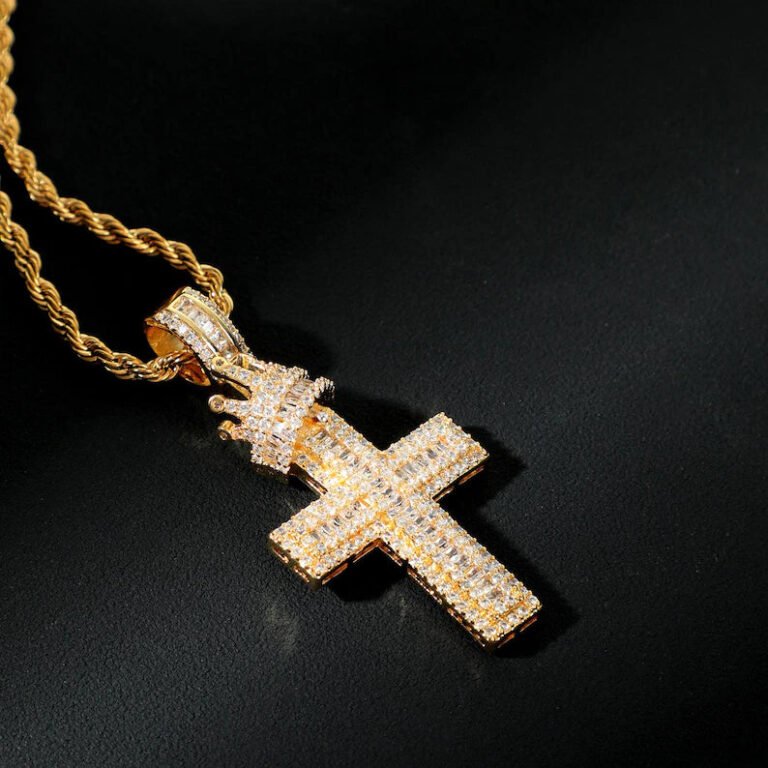
What “passes the diamond tester” really means
When a listing says moissanite “passes the diamond tester”, it means a basic heat tester will read it as diamond. It does not make the stone a diamond, and a jeweler or pawn shop with a multi-tester will identify it correctly. Many shops now use multi-testers, so moissanite won’t sell or pawn as diamond there.
For retailers this matters. Selling moissanite as moissanite is honest and protects your store. Customers who know what they’re buying are happy with it; customers who find out later are not.
FAQ
Will moissanite pass a pawn shop test?
It depends on their tester. An older heat-only pen may read it as diamond; a multi-tester will flag it as moissanite.
Does VVS moissanite pass a diamond tester?
Clarity doesn’t change conductivity. VVS moissanite tests the same as any moissanite. More on the grade in what are VVS diamonds.
Do lab-grown diamonds test as moissanite?
No. Lab-grown diamonds are real diamonds and test as diamond.
New to iced jewelry? Start with what iced out means or the complete guide to hip hop jewelry. Retailers: our iced pendants are made in 925 sterling silver with moissanite, lab-grown diamond or CZ. Message us on WhatsApp for the wholesale catalogue, or read our wholesale buying guide.