
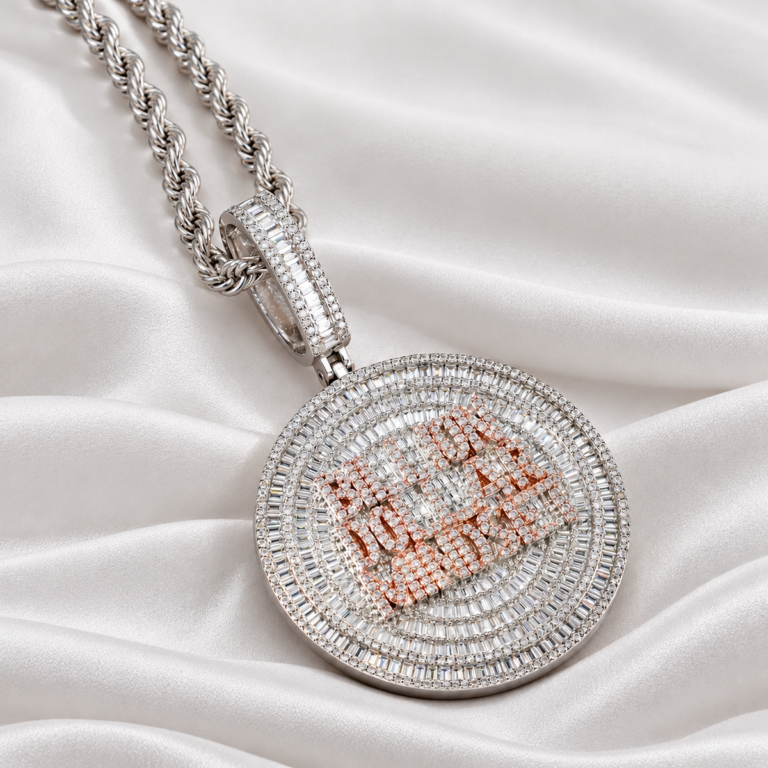
Most moissanite vs diamond comparisons are written for engagement rings, where one big center stone gets studied up close. Iced out jewelry is different. A pendant can hold hundreds of tiny stones, seen from a few feet away, worn every day. That changes which differences matter.
Short answer: for iced out pendants and chains, moissanite gives almost the same look as diamond at a fraction of the cost and holds up to daily wear. Diamond still wins on hardness, prestige and resale.
The basics side by side
| Moissanite | Diamond | |
|---|---|---|
| Made of | Silicon carbide | Pure carbon |
| Hardness (Mohs) | 9.25 | 10 |
| Refractive index | About 2.65 to 2.69 | About 2.42 |
| Sparkle | Strong rainbow flashes (“fire”) | Balanced white and colored sparkle |
| Price | Roughly four to five times less than a similar diamond | Highest; driven by cut, color, clarity and carat |
| Origin | Lab-created; natural moissanite is extremely rare | Mined or lab-grown |
| Size measured by | Diamond-equivalent weight (DEW) or millimeters | Carat weight |
Moissanite was first identified in 1893 by French chemist Henri Moissan in samples from a meteor crater in Arizona. Natural moissanite is so rare that every moissanite you’ll buy is made in a lab, a process that reached jewelry roughly a century later.
Why pavé changes the comparison
- Small stones hide differences. Moissanite’s extra rainbow fire is easiest to spot in a large single stone. Across hundreds of 1 to 2mm stones viewed at normal distance, both read simply as “ice”.
- Price multiplies. The price gap applies to every stone. On a fully iced pendant, that’s the difference between an everyday piece and a major purchase.
- Hardness is enough. At 9.25, moissanite is harder than almost anything it will knock against in daily life. It won’t cloud or fade with age.
- Setting quality matters more than the stone. A badly set diamond pendant looks worse than a well-set moissanite one. Read how iced jewelry is set.
What about lab-grown diamonds?
Lab-grown diamonds are real diamonds, chemically identical to mined ones, at a much lower price. They sit between moissanite and natural diamond on cost. If someone wants an iced piece that is genuinely diamond, lab-grown is the realistic route.
Diamond testers and resale
Moissanite conducts heat almost as well as diamond, so a basic heat-only tester will usually call it diamond. A multi-tester that also checks electrical conductivity will identify it as moissanite. Full details in does moissanite pass a diamond tester.
On resale, natural diamonds keep more value. Moissanite is bought to be worn, not as an investment, and should always be sold as moissanite.
Which should you choose?
- Choose moissanite for daily wear, fully iced pendants and chains, and the biggest look for the budget.
- Choose lab-grown diamond if it must be diamond but natural prices don’t make sense.
- Choose natural diamond for heirloom pieces, resale value or when the stone’s origin matters to you.
- Choose CZ only for occasional wear or costume pieces; it’s softer and can dull.
You’ll also see moissanite sold with a “VVS” grade. That’s a clarity term borrowed from diamonds, explained in what are VVS diamonds.
FAQ
Can people tell moissanite from diamond?
In a fully iced pendant at normal distance, very few people can. Up close, in a large stone, a trained eye may notice the stronger rainbow fire, and a multi-tester will tell them apart.
Does moissanite get cloudy?
No. If it looks cloudy, it needs cleaning: warm water, mild soap and a soft brush.
Is moissanite fake diamond?
Moissanite is a real gemstone in its own right, not a diamond. It becomes a problem only when someone sells it as diamond.
Back to the complete guide to hip hop jewelry. Retailers: our iced pendants use moissanite, lab-grown diamond or CZ in 925 sterling silver, such as the Iced Out KING pendant. Message us on WhatsApp for wholesale prices, or read our wholesale buying guide.