
VVS stands for “very, very slightly included”. It’s one of the highest clarity grades a diamond can get: any tiny internal marks (inclusions) are so small that even a trained grader struggles to find them under 10x magnification. To the naked eye, a VVS diamond looks flawless.
In hip hop, “VVS” took on a second life as shorthand for the cleanest, iciest stones money can buy. Here’s what the grade actually means, and how much it matters for an iced out pendant.
Where VVS sits on the clarity scale
| Grade | Meaning | What you see |
|---|---|---|
| FL | Flawless | Nothing, even under 10x |
| IF | Internally flawless | Only minor surface marks under 10x |
| VVS1 / VVS2 | Very, very slightly included | Inclusions very hard to see under 10x |
| VS1 / VS2 | Very slightly included | Minor inclusions under 10x; usually clean to the eye |
| SI1 / SI2 | Slightly included | Noticeable under 10x; sometimes visible to the eye |
| I1 to I3 | Included | Visible to the naked eye |
VVS1 vs VVS2
Both look flawless without magnification. VVS1 is the higher grade: its inclusions are so faint that an expert has real trouble finding them at 10x. VVS2 inclusions are slightly larger, darker or easier to spot, but still very hard to see.
Why “VVS” became hip hop slang
Rap has always used jewelry to talk about success, and clarity grades gave artists a way to say their ice wasn’t just big but top quality. Over the 2010s, “VVS” turned up in lyrics and on product listings so often that many buyers now use it to mean “flawless-looking stones” rather than a specific lab grade. If you’re still getting used to the vocabulary, our guide to what iced out means covers the related slang.
What about VVS moissanite?
You’ll see plenty of moissanite listed as “VVS” or “VVS1”. Moissanite is grown in a lab under controlled conditions, so much of it is very clean, and sellers borrow the diamond clarity terms to describe it. Two things to know:
- That grade is usually assigned by the seller or comes with a GRA-style card, not from a diamond grading lab like GIA. Treat it as a product description.
- VVS moissanite is still moissanite. The comparison with diamond is in moissanite vs diamond for iced out jewelry.
Does clarity matter on a fully iced pendant?
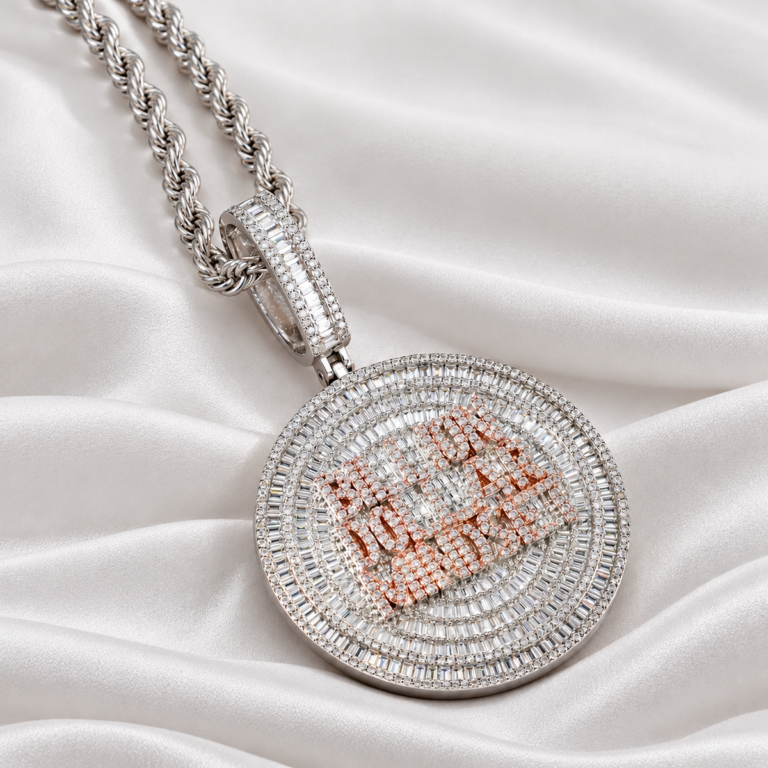
Less than you’d think. On a pendant set with hundreds of 1 to 2mm stones, nobody can see inclusions at arm’s length, even in lower grades. What decides how much a piece sparkles is mostly the cut of each stone and how cleanly they’re set, not whether they grade VVS or VS. Clarity matters most in larger single stones, where an inclusion has room to show.
What do VVS diamonds cost?
VVS diamonds cost more than VS diamonds, sometimes a lot more, even though most people can’t see a difference without magnification. That premium is the reason a fully iced pendant in natural VVS diamonds is so expensive, and why moissanite and lab-grown diamond have taken over much of the iced market.
FAQ
Are VVS diamonds real?
Yes. VVS is a clarity grade for real diamonds, natural or lab-grown. If a seller claims VVS diamonds, ask for the grading report.
Do VVS diamonds get cloudy?
No. A diamond that looks cloudy is almost always dirty. Clean it with warm water, mild soap and a soft brush.
Will a VVS diamond pass a diamond tester?
Yes, any real diamond will. So will most moissanite on a basic tester, which surprises people. See does moissanite pass a diamond tester.
Is VVS worth paying for?
For a single large stone where rarity matters to you, it can be. For pavé on an iced pendant, a well-cut VS stone or quality moissanite gives you the same look for less.
More on stones, metals and styles in our complete guide to hip hop jewelry. Retailers: message us on WhatsApp for our wholesale catalogue of iced pendants in 925 sterling silver.